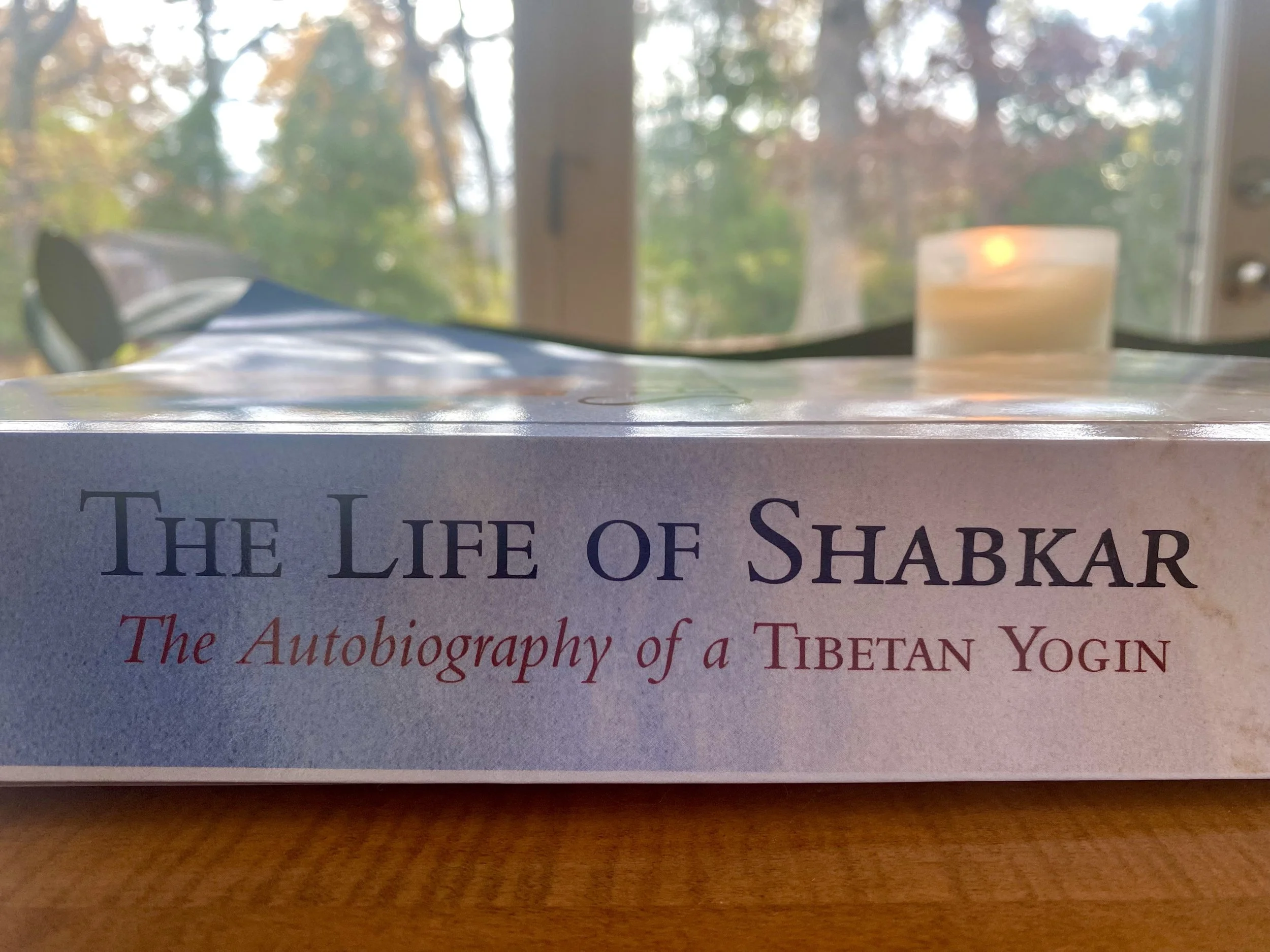
I love the kind of modern books on Buddhism that you’ll find at a Barnes & Noble, but it’s feels special and exciting to read the source material that contemporary dharma draws from. These old texts always demand of me a layer of interpretation and unpacking. The tendency for men (including Shabkar) to abandon their families for practice always makes me feel prickly (Like can you not pay your mother the occasional visit? Can’t a cow-herder also recognize Dzogchen, as it is said?), but I like that as a reader, I’m the one who is challenged to approach the text as it is rather than have the text be chopped up and cooked into a more palatable form for me. It ends up feeling like a sort of collaborative effort between myself and the teacher, where we are reaching out to each other across time and culture and form to discover how their lived experience resonates in my own mind and practice.
So often I’ve thought of transmission in Tibetan Buddhism as a kind of “pouring” of dharma into one container from another, when really what seems to be happening is an shared exchange, a feedback loop where dharma isn’t only received by the students but feeds back into the source, thereby also changing the teacher and teachings. This feels akin to some of the work I’ve seen others do who work within belief systems where ancestors play an important role. The ancestors, while deceased, can continue to develop and change and heal through the discoveries of their descendants. For me personally, this relationship with ancestors doesn’t feel antithetical to rebirth, as it is not the self that is reborn, but the karmic habits of beings, and birth and death themselves aren’t what they seem to be. The Ati state is sometimes described as “unborn” to communicate this layer of reality which is both beyond and integrated within death and birth. The implications of this feel more thrilling and probable to me than the idea of “going beyond” as a perpetual stasis or quiescence. In this way, we are changed by Shabkar, and Shabkar continues to change.